

The Antisemitism Beat
Interview with Arno Rosenfeld, the Forward’s antisemitism reporter
Hello and Welcome to the Documensch Newsletter,
There’s a chill in the air and we’re not talking about winter. Federal agents are going door-to-door in Minnesota and other places asking for papers and abducting folks. These same agents are shooting at and in some cases killing people they perceive to be in their way. The US is working diligently to upend the global world order established in the wake of WW2 with threats to annex Greenland. Iran is on the brink. What year is it again and how crazy will it be for the Jews?
To ground us for the new year, we spoke with Forward antisemitism beat reporter Arno Rosenfeld about covering antisemitism, how it has changed in recent years, and how archives and history might help us better understand what’s going on today.
We’ll be back in a few weeks with the Documensch Research Report. In the meantime, check us on the Documensch Daily website or on Bluesky to get your fix before then.
Comments, suggestions, and questions are always welcome: bermanarchive@stanford.edu.
-Ari
Ari Y Kelman, Director, Berman Archive
The Antisemitism Beat: Interview with Arno Rosenfeld, the Forward’s antisemitism reporter
This has been a head spinning week for antisemitism in the news: there was an arson attack on a synagogue in Jackson, Mississippi and then former NYC Mayor Eric Adams released a cryptocurrency that purports to fight antisemitism. To help us sort the circus from the crisis, we connected with Arno Rosenfeld, the award-winning Forward reporter on the antisemitism beat. He’s been covering the institutions, politics, and flashpoints of antisemitism, and writes the excellent Antisemitism Decoded newsletter. We interviewed him over Zoom this week.
Tell us a bit about your journalistic focus. What are you working on? What’s your beat?
I’ve been at the Forward since 2020. And over that time, and especially over the past couple of years, my focus has really narrowed to antisemitism and especially the kind of politics around antisemitism. I do cover antisemitic incidents themselves, but I also cover the way that Jewish philanthropy has gotten involved in antisemitism, the debates over how to define antisemitism, what’s been happening on campus, and the federal approach to antisemitism.
When you were a budding young journalist, did you ever imagine that you would be on the antisemitism beat?
I got my start in Jewish journalism back in high school and have written for Jewish publications on and off. So in that sense, it wasn’t foreign to me. But I do remember when I was first put onto the beat back in 2020, and I thought to myself at the time, don’t we sort of know this story? It’s tragic that there are still these manifestations of antisemitism, but that’s not really new. In pretty quick order, I found out that I was wrong. I think it was a mix of both things that I had not realized, not having been steeped in it, and just genuine changes in the political landscape, in the Jewish landscape, and in the landscape of antisemitism over the past few years that really did make it a much more compelling subject.
How do you keep your head up when it seems like one crazy thing after the other?
I think this is sort of a pretty universal, American or perhaps just human experience these days. So I don’t know if it objectively makes it any better, but I think there’s a lot of news that one could get depressed about out there. So I think that’s useful for perspective and context to keep in mind: Jews are not the only ones dealing with an onslaught of very upsetting things impacting them personally or impacting their communities. I think that just part of being a journalist is trying to cover these things at a little bit of a remove. If anything, part of my goal is not to become numb to this stuff because there are two paths you can go down—you can just become paralyzed by how depressing and bleak everything is, or you can become numb to it. I think it’s healthy for all of us to try to sit somewhere in the middle.
What do you read to stay tapped into antisemitism discourse?
You know, it’s a hard thing to stay on top of, in part because so much of the important conversations are happening in online spaces that are just an absolute fire hose. When you think about some of the antisemitism that we’re seeing in the manosphere, for example, these podcasts—Joe Rogan, Theo Von, Myron Gaines, who’s much farther to the right—they’re all posting hours and hours of content, sometimes on a daily basis. It’s just literally impossible to stay abreast of all of it. And that’s a real challenge. I’ll dip my toe in here and there when I’m working on a story, but I don’t have like seven screens up all day.
Obviously, I read the Jewish press. You know, both the Forward and the JTA are doing a lot of excellent work. Then there are another half dozen publications that cover a lot of this stuff. And then I read a lot of local media. I have Google Alerts set up for various relevant terms. And often some of the best coverage, and I would say most important coverage, is coming from the local press because they’ll be tracking a story from its origin. As a general rule, I think that the most clarity often comes from the people who are actually on the ground themselves and can give you that context that you may not understand.
What do you wish American Jews could better understand about antisemitism today?
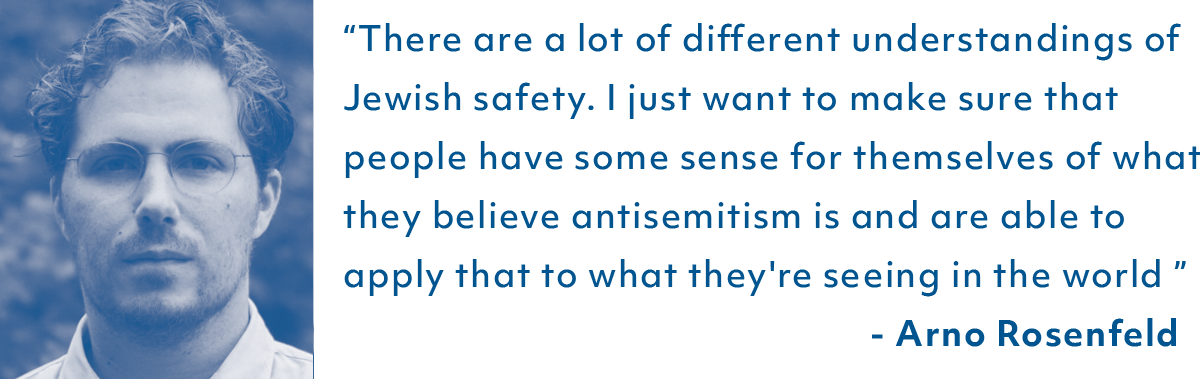
I think there has been and this has been true for actually a long time, arguably since the start of the 20th century. But there’s often a gap between what the national leadership of Jewish organizations says are the most pressing problems facing Jews when it comes to antisemitism and how Jews might themselves understand antisemitism. And I think there’s a degree of deference that people are used to making there, especially before this was as politically charged as it is now, where you said, okay, if this organization said there was an antisemitic incident or that a politician made an antisemitic comment, I’m just going to take that at face value. Now I think there are well over 75 new nonprofits created to fight antisemitism. And that’s on top of all the existing organizations. And so many people are sort of claiming the mantle of defending Jews, of calling out antisemitism, that it’s really important for people to just do that one extra layer of investigation. There are a lot of different understandings of Jewish safety. I just want to make sure that people have some sense for themselves of what they believe antisemitism is and are able to apply that to what they’re seeing in the world because I think that’s helpful at a time when all these different people are inserting themselves into these debates.
That’s one thing that I try to do with, you know, the Data Decoder section in the newsletter because there are sometimes just truly faulty polls that should be ignored. So it tries to take those charts and surveys and say, “here is what we can learn from this.” And that’s something that even at the Forward we often don’t have time to do in an individual news story. It’s just not the way the media is really set up to operate.
In 2026, do you think we’ll be seeing more academic institutions being punished by the federal government in the name of antisemitism?
I don’t know, it’s hard to predict exactly how the Trump administration will proceed with these campaigns. On the one hand, many universities have been eager to settle these lawsuits, which might encourage the approach as one that’s effective. And at the same time judges have taken a sort of skeptical view of the legal basis for these sanctions, which might empower more universities to push back or it might cause the administration to slow down some of its push. I do think that as the war in Gaza sort of winds down, there’ll be less activism on campus, which was the impetus for a lot of these investigations—a lot of them dated back to the Biden administration, then Trump picked them up. My sense is that a lot of the highest priority or most pressing ones were addressed in 2025 in one way or another.
So we have to ask, how do archives factor into your work, and do you have a favorite archival item you might want to share with our audience?
So archives factor significantly into my work because I think that one thing that’s often missing from the way we talk about antisemitism today is historical perspective. So when people say things like, “it’s never been worse than it is now.” Or “my parents or my grandparents could have never imagined this,” what does that really mean and how do we find the answer to that question? And some of the answer is traditional reporting methods: interviews with people who were working on this stuff decades ago, but another part is archival research. So I spend a lot of time in JTA’s archive. Of course, the Forward didn’t publish in English until the 90s. So our archive is a wonderful resource, but it’s less accessible to me for the kind of research that I’m doing. The American Jewish Committee has a great archive. You can actually trace the evolution of concern over antisemitism from their polling dating back to the 90s. And you can try to get a sense of what were the historic events going on at this time that would have accounted for rises and falls.
I don’t want to say that this is my favorite of all time, but in relation to the arson attack in Mississippi, there was the slate of synagogue bombings in Southern states in the 1950s and 1960s. The American Jewish Committee actually put together a messaging document that says, our strategic communications priorities are to talk about them in these ways and they were very specific. So they said, we don’t want to call the perpetrators racist, we want to call them hoodlums. We’re trying to emphasize the rule of law over antisemitism. They had a big emphasis on intergroup relations so they were talking a lot about, how do we get people to rally behind the Jewish community? How do we present this as a threat to all different communities as opposed to a threat just to Jews? So it’s a really fascinating document, and there’s a lot of that stuff out there, you know, if you poke around.